
#1. Cross-country skiing in Maine: January 2-4, 2019

Martha Alden had been my best friend in kindergarten when we both lived in Ellsworth, Maine. Alas, my parents moved to Bangor and hers to Stockton Springs by the time I was in second grade, and we might have lost contact, had it not been for our mothers who decades later crossed paths at a social event. I did manage the occasional Christmas card and a visit to their home as our kids were growing up. Otherwise, it was fast-forward to some 40 years post-kindergarten that Martha and her husband Dave came for dinner at our house in New Orleans. Somehow that dinner resulted in an invitation several years later for me to join Martha, her older sister Peg Stout, and her college friend Marty Grant for a three-day cross-country ski trip in northwestern Maine. The Maine Huts & Trails Association had recently established a series of three larges huts (lodges) connected by trails, perfect for cross-country skiing in the winter and hiking, swimming, canoeing, and other sports in summer.
My husband Bill Bertrand had introduced our family to cross-country skiing over three decades earlier during our annual trips to spend Christmas with my mother in Maine. Despite growing up in the state of Maine, I had never become adept at downhill skiing, but I had come to love cross-country skiing – for which there is zero opportunity in my adopted state of Louisiana. Thus, an invitation to do more of the same had great appeal. For years I had reproached Bill for the extravagance of buying cross-country skis, boots, and poles during our early years of skiing, given that we would only use them for one week a year. Yet 30 years later, there I was, using these same boots, skis, and ski poles.

The Group of Four started this tradition in 2012, when we were aged 61 to 63. Little did we know how well-matched physically and how socially compatible this group would be.
Martha had received her Masters in mathematics, raised three kids with her husband Dave, reveled in her grandchildren, and continued to tutor students in math at the UMA/Augusta. Her sister Peg, two years older, was an educational specialist who had moved from Maine with her husband Marty to Maryland, where they worked for several decades before returning to Maine for retirement. Peg had hiked the Appalachian Trail in sections and wrote a book about her experience in 2012 entitled Letters from the Trail.

Marty Grant had been Martha‘s college friend at Colby College. She had taught French and Spanish for 30 years in the Maine school system, occasionally brushing up on her French with the trip to France. Whereas all of us worked on staying fit, Marty was by far the most disciplined: swimming, hiking, cross-country skiing, canoeing, exercising religiously. She was often the leader of the pack as we wound through the snowy trails of backwoods Maine.
There were several constants to this trip. It usually occurred the first week of January, and we came to schedule our lives accordingly. Second, except for Martha, we wore the exact same ski parkas for eight years running: Marty in fuchsia, Peg in white, and mine in kelly green (purchased during my last year of graduate school in Chicago in 1976 and worn as a badge of honor to see how long it would last). The photos from one year to the next were indistinguishable: the background never changed, nor did the colors of the ski jackets.

The third constant, instigated after our disastrous first year at Maine Huts and Trails (more later), was to return each year to the same lodge - Flagstaff – rather than to ski between lodges. From the parking lot at the trailhead, we would ski to Flagstaff, spend two nights there, and ski out. The middle day allowed us to take short excursions along one of the multiple trails: to a snow-covered bridge, to a yurt, or the service road.
The fourth constant was the accommodation in the lodge. We slept in the room with bunk beds, where the temperature hovered around 55°, inside. The toilet facilities were in the main lodge, requiring a trip in the night through the snow, before we finally adopted a chamber pot alternative. The staff consisted of three young people who accepted assignments of several months each to cook breakfast and dinner nightly for 3 to 40 people, clean the rooms, maintain the environmentally friendly septic system, and ensure the upkeep of the lodges, in return for living in a glorious backwoods environment. I could never figure out how this group of culinary novices produced gourmet dishes at every meal, which tasted particularly delicious after a few hours on the trail. Did the lack of electronic distractions give them extra time to focus on food preparation?
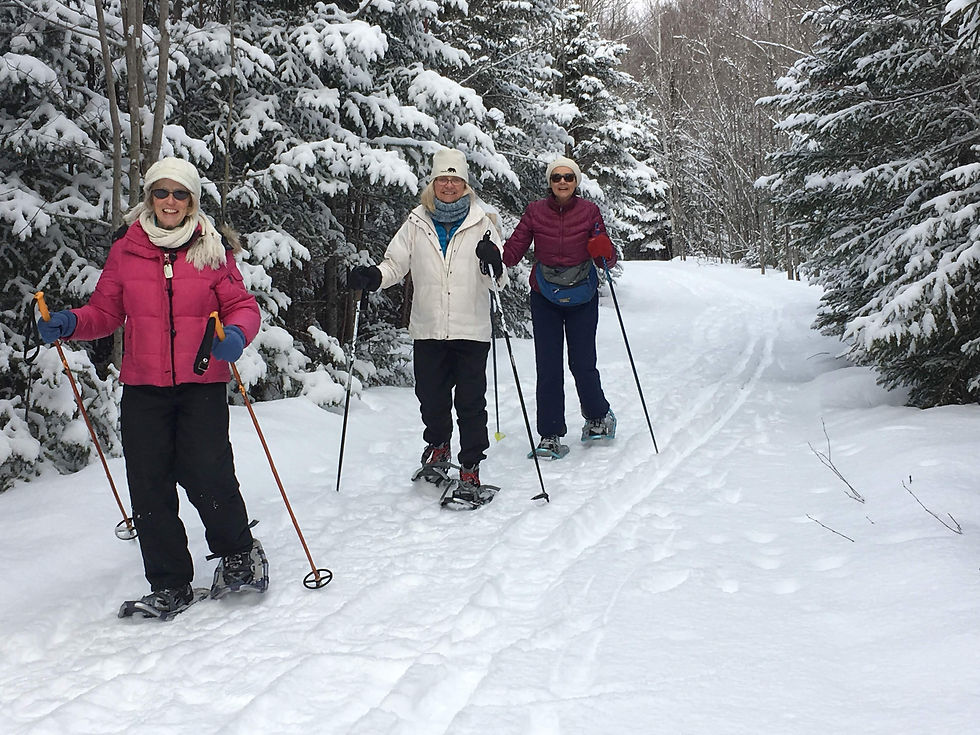
By January 2019, this tradition had taken place for eight years in a row, though I had missed one of the years. As was often the case, we obsessed over the weather conditions, “possible lack of snow,” and constantly monitored the trail conditions on the Maine Huts and Trails website. Our first encounter in 2012 - when we didn’t know better – involved a seven-hour slog between the Popular and Flagstaff huts. By the time we stopped for lunch, our tuna fish sandwiches had already frozen. The trail consisted of icy patches of snow, pools of water that had melted, and slippery roots. Midway through the hike, Marty crashed through a thin spot in the ice, completely immersing her boot in the freezing run-off. Without a word of complaint, she plodded back to Flagstaff with a very cold foot. Was this my introduction to the upbeat attitudes of a “can-do” group of women?
In 2019 we worried about the weather forecast and wondered if the predicted rain the day prior to our arrival would wipe out whatever snow had built up on the trails. I had gotten as far as to call Martha to see if we needed to postpone until later in the season, but everyone’s life was too closely scheduled to make that a possibility. Instead, we decided to take our chances, but we packed both cross-country skis and snowshoes. It took less than five minutes on the trail on skis before we headed back to the car to pick up our snowshoes. This tradeoff was fine by me, since I’ve never snowshoed and wanted to experience it. The 1.9 miles trail into Flagstaff Hut from the parking lot consisted of crusty snow, too slick for comfortable skiing.
We feared that the forecasted snow would not arrive in time to be of any use to us, but on Day 2 we awoke to six inches of fresh powdered snow, which added to a substantial base on the trails. The conditions went from unacceptable to near ideal. We donned our snowshoes, hiked back out to the car at the trailhead, traded snowshoes for skis, and headed back into the lodge. That afternoon, we went back out for another glorious two hours of gliding across the groomed trails of the backwoods of Maine. The sky was bright blue, the boughs of the fir trees laden with snow.

How did this group of “senior ladies“ enjoy such perfect health? They didn’t. Only during this trip did I learn that Marty Grant has scoliosis. Her disciplined exercise routine is her antidote to succumbing to the effects of this disease. Martha struggled with a bum knee and put on her black knee brace before each outing. A month earlier, I was diagnosed with a strained gluteal muscle in the left hip, which a Tulane doctor at the Sports Medicine Institute viewed under ultrasound and strategically injected some chemical remedy into the tissue. The ski trip would be a test of whether the injection had done the trick or not (happily, it had). Peg was the only one totally injury-free, though she almost missed a trip after her husband took a fall. Though it remained unspoken, all four of us valued this early January ritual, and no one wanted to be the first to pull out for health reasons.
The skiing conditions were superb. The four of us were a well matched group. Marty invariably took the lead, with the rest of us working to keep up. Where the trail forked, she would wait for us to catch up, ensuring that we all stayed on the same trails. It was pure exhilaration, chasing Marty over the near-perfect trails, panting to keep up with her as she glided effortlessly along, thrilled that my medical procedure at the sport Tulane Sports Institute seemed to have done the trick in restoring my hip to good health.
Often we had the lodge to ourselves, as families with kids headed back to school after the holidays. This year we shared it with a couple, their five kids, and two seniors whom we mistook for the grandparents. In this very communal environment, we gradually learned of the multiple overlapping connections we had. The wife had worked in family-planning; the husband had taught for over 20 years in international schools (similar to the one our daughter attended in kindergarten in Kinshasa). They had attend Camden (Maine) High School, where they had had our friends Barbara and Bill Bentley as teachers. He had borrowed his skis for this trip from the older brother of my best friend from second grade, Charlotte Stetson. She was the niece of a colleague who chairs the Department of Epidemiology at Johns Hopkins, and whose ex-wife had been my gynecologist during my years in Baltimore. When I learned that the wife was writing a book – a memoir of sorts - I produced my own recently published memoir on highpointing, which featured both Barbara Bentley and Charlotte Stetson as fellow travelers. She was facing the challenge of trying to get her memoir published versus self-publishing and was curious about my experience. Reluctantly, we parted ways, having only scratched the surface on these many connections.

I capped off two nights at the Maine Huts & Trails lodges, followed by a 2.5-hour ride back to Martha’s house, by joining Martha to volunteer at the celebration for the inauguration of the first female governor of Maine, Janet Mills. Martha assured me that in Maine, “people wear anything to these events.“ Peg lent me a long blousy top that I might wear over my black jeans, the fanciest item of clothing I had for this week in Maine. We did notice the invitation said “black tie: optional,“ which should have been our tip that most guests and the vast majority of volunteers would show up dressed to the nines: floor-length strapless gowns, three-inch heels. I arrived vastly underdressed for the occasion. But ss we scanned the tickets of the guests arriving en masse for this event, I soon forgot my totally inappropriate outfit and wished I were wearing my Kelly green parka, as gusts of freezing air burst through the door with each guest.
Although we were in the 8th year of the January cross-country tradition, it was #1 in my quest to complete the 80 “extraordinary outdoor excursions” by age 80. Only 79 left to go.
*************


Comments