
#13. Hiking Doubletop Mountain, ME: August 9, 2020

Updated: 6 days ago
In past summers, climbing Katahdin was the marker of a successful vacation in Maine. Reaching the summit was a challenge, but always a rewarding one. This year, when Barbara M. S. Bentley emailed me to ask if I would join her for an alternative hike within Baxter State Park to Doubletop Mountain. I jumped at the chance. I’d seen this mountain with its distinctive outline from a distance. But I'd never made the climb, in part because in the past, a trip to Baxter State Park needed to target Baxter Peak, the summit of Katahdin. This year, it didn’t.
I had known Barbara from childhood. Her father, a surgeon, directed the Eastern Maine Medical Center in Bangor, ME, where my father came to practice when I was seven. We had enjoyed many Thanksgiving meals in their large Victorian house. Although Barb was three years ahead of me in school, we'd both been on the Bangor YWCA swim team. And we'd both gone to the Girl Scout camp at the foot of Katahdin, Natarswi. The McEvoys were avid outdoorsmen who made a family pilgrimage into Russell Pond each summer. Barbara knew every nook and cranny of Baxter State Park, and in retirement, she served as President of Friends of Baxter State Park for seven years. In short, I'd be hiking with a pro.

By summer 2020, COVID-19 had become a major pandemic worldwide; all the more reason to choose an outdoor activity. While other states had a growing number of hotspots, Maine had largely dodged the bullet.
I reserved my room for two nights at the Moose Big Inn, eight miles from the entrance to Baxter State Park. Barbara had invited me to join her at Abol Campground, where she was spending the night in a lean-to on a hard floor with three other people. I had declined. On the morning of the hike, I drove from the Inn into Baxter State Park and met her at the campground. My quick assessment of the lean-to situation confirmed that I had made the right decision. Clearly, I was losing my adventurous spirit for the great outdoors in favor of the creature comforts found at Big Moose Inn.
From Abol Campground, we then drove another 15 miles down the dusty dirt road to the unpronounceable Nesowadnehunk Stream Campground, the trailhead for Doubletop.

Barbara knew every corner of the park, including the bridge from which to get the postcard-perfect photo of Doubletop.
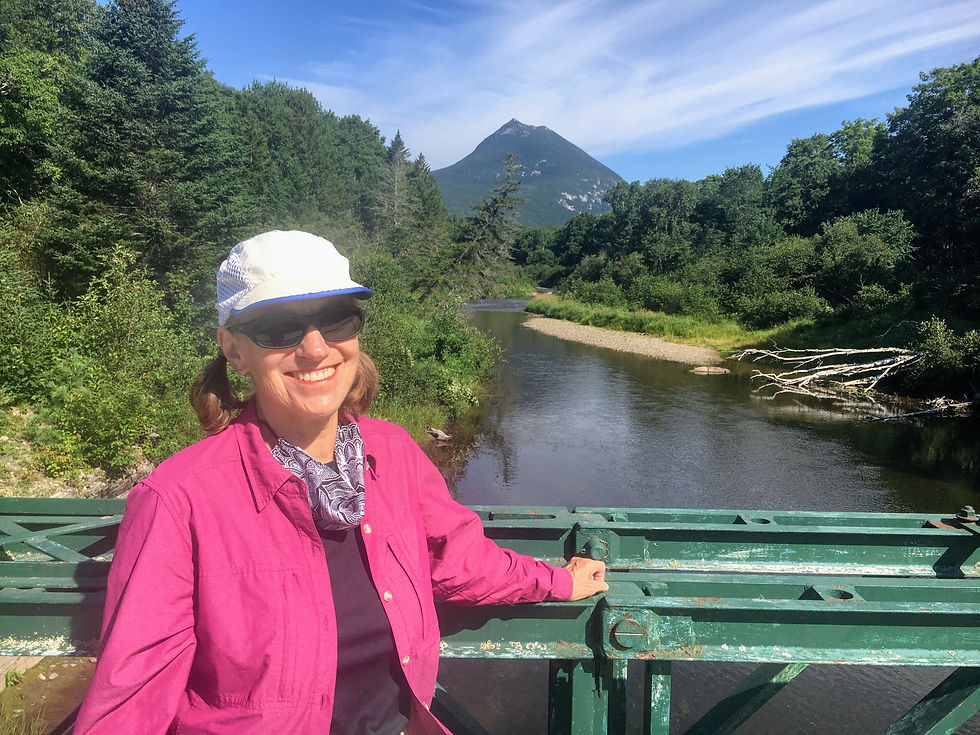
We started up the trail after 10. The first two miles were relatively flat, but required some stream crossings before the climbing began. Barbara and I managed to cross the Doubletop Brook without slipping into the drink.

During those first two miles, I peppered Barbara with questions, and she carried on a full conversation as she pushed forward. When we hit the next two miles of steep, rocky trail, Barbara started asking me questions. No way I could climb and talk at the same time. Had I been asking her all those questions so she’d have to do the talking, not me?

We reached North Peak, the first of the two summits, and had a quick lunch of PB&J, as we reveled in the northern Maine wilderness on all sides. Barbara identified the many mountains and rivers within view. She recounted that Henry David Thoreau traveled by canoe through Northern Maine, following ancient Indigenous canoe paths, in the mid 19th century, and gestured toward some of the places he'd visited: the Chesunocok Lake and Ambejejus Lake, among others. She pointed out the mountain directly in front of us named Mount OJI, because the rock face once formed the letters O-J-I (less visible now thanks to hurricanes and erosion). We were joined by a couple from Puerto Rico who were pleased to find some Spanish speakers in Maine.

After lunch, we took the quick 0.2-mile hike to the South Peak. How could we claim to have climbed Doubletop if we didn’t make it to both peaks? Having reached the second summit, we reversed course and headed down. The trail down was considerably easier, except on the knees, and we arrived back at the car shortly after 4 pm. We had completed six miles in six hours, which Barbara confirmed was the estimated time given by the guidebook. In our earlier days, we might have been disappointed if we didn't finish the hike well under the estimated time, but at this stage in life, we'd take just making it.

Just after exiting Baxter State Park, we came to Upper Togue Pond on the opposite side of the road from Natarswi. The beautiful sandy beach gave us the chance to wash off the sweat and dust from the hike. We might have been in the water for only five minutes, but it was exquisite.
Barbara had made a reservation for 6:30 PM at the New England Outdoor Center restaurant. We were seated in a lovely dining room with socially distant tables beside an open window with a screen. We celebrated with drinks and a delicious dinner, during which we continued to hash out every topic that we had not covered during the previous six hours. She returned with me to the Big Moose Inn, where she had rented “the boathouse" for the night. Although part of the compound, it was hardly large enough for the double bed and had no bathroom. The advertisement read: “If you’ve been sleeping in a tent, this will be heaven.” Barbara opined that next time, she might take the tent.

I was happy to spend a second night at the Big Moose Inn, thus avoiding the 1.5-hour drive back to Holden, solo and exhausted from the hike. After eight hours of sleep, I rolled out of bed, ambled downstairs for breakfast, and checked my email. Barbara had already left for a solo hike up Trout Mountain (1.1 miles each way). At age 74, she remained my role model for staying active.
If the excursion had been drama-free, the aftermath was not. I had already returned to my home base in New Orleans when Barb contacted me. Had I heard about the COVID outbreak linked to the Big Moose Inn? Although most social events were cancelled in 2020, the Big Moose Inn had hosted a wedding attended by 55 people the night before I checked in. Barbara got tested immediately and fortunately was negative. Others were not so fortunate. The event became an epidemiological case study in the spread of the virus. As guests fanned out across the state after the wedding, the multiple outbreaks it triggered reached as far as a long‑term care facility 100 miles away and a correctional facility 200 miles away. The CDC estimated that the wedding resulted in 177 cases of COVID and seven deaths, as reported by CNN and other national news outlets. So much for Maine being a safe haven during the pandemic.
************


Comments