
#68. Leaf peeping in Maine: October 11-16, 2026

Updated: Oct 20
Hadn’t I seen enough fall foliage, growing up in Bangor, Maine? Apparently, it never gets old, and as October approaches, so does the desire to return north. For many years when we had kids and full-time jobs, it was unthinkable to take a week off in the middle of October. But in retirement, life was moving at a different pace. When I realized that I had nothing on my calendar for the week that Mainefoliage.com considered “peak” for Bangor, Maine, and frequent flyer miles were burning a hole in my pocket, I jumped on the Delta website and made my reservation.

If viewing the foliage is nice, hiking in it is even better. I contacted Charlotte Stetson, my best friend from second grade, to see if she would be available for a hike. Of the five days I’d be in Maine, only one promised a full day of sunshine, so we set our sights on hiking in Acadia National Park that day. In her email, Charlotte had cryptically said, “I’d like to do a hike that includes North Ridge of Dorr Mountain. I won’t go into the reason why here but will explain when I see you.” I was happy to follow her lead, since she had climbed all 26 peaks in Acadia National Park, most of them multiple times.

On my first day in Maine, the weather changed for the better and offered a second sunny day for hiking, albeit solo. I decided to head to Camden Hills State Park for three reasons. The bang for the buck would be excellent: a one-hour drive to a relatively easy hike that promised gorgeous views over Camden and the Atlantic Ocean. There would be others on the trail, should anything happen. And it would require passing by Dot’s Market, the best source of blueberry muffins in the state.
By noon, I found myself on the familiar road from Holden to Camden. The sun was showing off the foliage to its best advantage. The roadside was ablaze with color: deep red, bright orange, burnt orange, and canary yellow. Sometimes a single tree would fade from green to orange. It was early enough in the season that the leaves had yet to blow off the highest branches, adding fullness to the trees. Route 46 took me past White’s Orchard in Bucksport, where I stopped to buy 20 pounds of Cortland apples to take back to New Orleans. After a few more miles of mesmerizing scenery, I reached the Camden Hills parking lot.
The weather was perfect: sunny skies but crisp fall air. Since it was Indigenous People's Day, I had plenty of company on the trail: couples, families, and dogs. In a quick hour, I reached Ocean Lookout. In past years, the winding shoreline and expansive blue ocean had been the main attraction. This year it was the field of brilliant foliage just under the Lookout. THIS was the reason I’d come to Maine.

As I oo’d and ahh’d over the brilliant colors to fellow hikers at the top, I mentioned, “I came all the way from Louisiana just to see those colors,” then for no particular reason added, “but I went to Bangor High School.” This caused the woman with whom I was chatting to ask, “Did you overlap with any of the McEvoy children?” I explained that I’d known the McEvoys even before I started kindergarten (see excursions #13 and #18). Small world.
The trip to Camden Hills was the warm-up to the main event: hiking in Acadia with Charlotte. As usual, we rendezvoused in the parking lot of the Trenton Health and Rehabilitation Center and rode together to Acadia. En route, Charlotte explained that she was a “Waldron Warrior,” a volunteer responsible for checking the cairns on a specific trail in Acadia National Park four or five times a season. This would be her fourth and final hike this season to fulfill her duty.

Because it had rained for two days beforehand, the trail was still wet in places, but from the get-go, the foliage overhead and on the nearby peaks was spectacular. Twenty minutes into the hike, we arrived at the first cairn, and Charlotte explained the nature of her task. A cairn is a man-made stack of rocks that marks the trail, indicating the direction to follow and reassuring hikers that they are on the right route. (The trails in the park are also well marked with bright blue blazes on rocks or trees.) In Acadia, each cairn is supposed to consist of four rocks: two at the base about 6-18 inches apart, a third that sits atop the two bottom rocks, and a fourth with a pointed edge that serves as an arrow indicating the direction of the trail.

Charlotte explained that hikers who don’t understand the system often change the position of the pointer rock or place additional stones on the cairns, thinking they are there for decorative purposes. A second type of trail marking exists to dissuade hikers from taking the wrong turn at an ambiguous fork: either a horizontal log or a line of stones barricading the path.

From her previous work on North Ridge of Dorr Mountain, Charlotte knew that she was looking to check 48 cairns. With notebook and pencil in hand, she entered each number and put a checkmark beside those that were satisfactory. Most were. But she was dumbfounded to come across one of the larger cairns that, as placed, would send hikers in the wrong direction: directly over a line of stones to what was not the trail. It was no small matter to disassemble this pile of rocks and relocate them well off the path. “Too bad those guys just passed us,” Charlotte commented. She documented the erroneous stone structure with a photo, dismantled it, and dutifully reported it in her notebook.
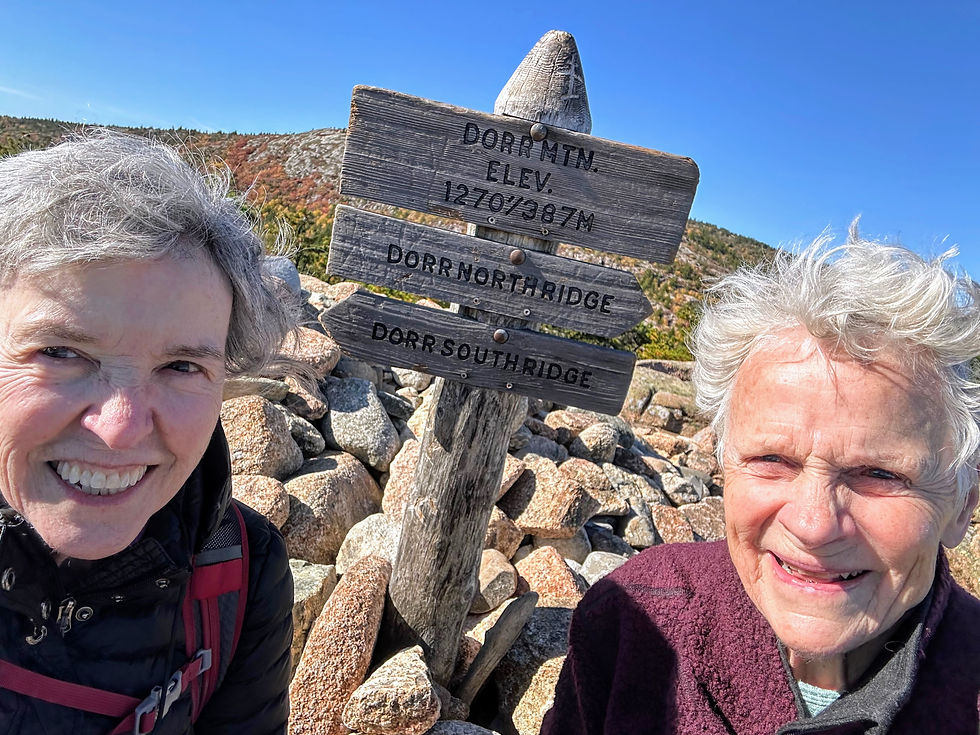
Charlotte and I are very well matched for hiking, and she was able to choose routes that would be challenging but not excessively so. After completing the North Ridge of Dorr Mountain, she was off duty. If we wanted to hike from there to Cadillac Mountain (which we did), it required 0.2 miles down a trail of large, ragged boulders, followed by a 0.4-mile ascent on similarly large boulders on the other side. As we gingerly inched our way down, I consoled myself that it was only 0.2 miles. Minutes later on the other side, as we hoisted ourselves over the boulders toward the top of Cadillac Mountain, Mocha, a 3-year-old mixed-breed, bounded up energetically, making it look easy; her owners struggled to keep up.

If the rest of the day’s hike could be classified as “moderate,” this short stretch of down-then-up was closer to “strenuous.” I made a mental note that for the rest of my eight annual extraordinary outdoor excursions, "moderate" would be just fine. But I could hardly complain. We spent most of the day on wooded trails covered with a mosaic of fallen leaves or massive slabs of granite rock with breathtaking views of colorful forests, Bar Harbor, and the vast expanse of the Atlantic Ocean.

Cadillac Mountain, the highest peak in Acadia, is a favorite destination for the millions of park visitors each year. I, too, have brought guests there many times. It was somewhat jarring to emerge from the pristine wilderness trail into the blacktop parking lot swarming with buses, cars, and people. We retreated to the granite slabs some 100 yards from the main outlook for lunch. Charlotte explained that our picnic spot was the true summit of Cadillac Mountain. Who knew.

From there, we headed down the Cadillac North Ridge Trail toward the Sieur de Monts parking lot. I was overjoyed when Charlotte asked, “Jane, where do you think we should go for our next major hike?” (In addition to Mount Katahdin and other places in Maine, we had hiked together in Chile, Montenegro/Croatia, and Yosemite National Park). I mentioned Iceland, but she had been there. We considered Argentina but put it on the backup list. “What about the island that starts with M and is the name of a wine?” suggested Charlotte, who couldn't remember its name. We had already moved on to several other topics of conversation when, out of the blue, Charlotte cried out, “Madeira.” A second option was the Azores. Both sounded exotic, and we resolved to do our homework and find a good date.
Whereas hiking in Acadia at the height of the fall foliage was the primary motive for this trip, a stop at Morton’s Moo (ice cream shop in Ellsworth that I had discovered several months earlier) was a strong second. The traffic leaving Acadia National Park was far heavier than I had imagined. As we crawled along the highway off Mt. Desert Island, I checked the closing time for Morton’s: 5 PM. I picked up my car in the Trenton parking lot, said my goodbyes to Charlotte, and continued toward Ellsworth. It seemed highly unlikely that I would make it to Morton’s by closing time, but I surprised myself by hitting all the lights just right and pulling up in front of the store at 4:59 PM. They were still serving customers, and I indulged in a Mocha Oreo waffle cone. The perfect ending to a perfect day.
I’d be leaving the next morning on a 5:19 AM flight and had not yet procured a second bag of Maine apples. (During my brief stay, I was told that the best apple pie comes from combining Cortland and Macs.) Charlotte reminded me that Johnson’s Orchard was 1 mile off Route I-A on my way home. When their sign popped up along the highway, I took that left-hand turn down the country road to the Apple Store. It was 5:30 PM, and the owner was just locking the door. He looked at me and hesitantly asked, “Can I help you?” I answered, “I’m hoping to get a 5-pound bag of Mac apples to take back to Louisiana.“ He smiled, reopened the store, and handed me the bag of large red apples. This was true lagniappe.
The next morning, I woke at 3:15 am, arrived at the Bangor airport by 4:15 AM, and checked a 42-pound suitcase filled largely with apples. Despite my sleep-deprived state, I was overwhelmed by the feeling that “this trip had been so worth it.“

*************


Comments